
0
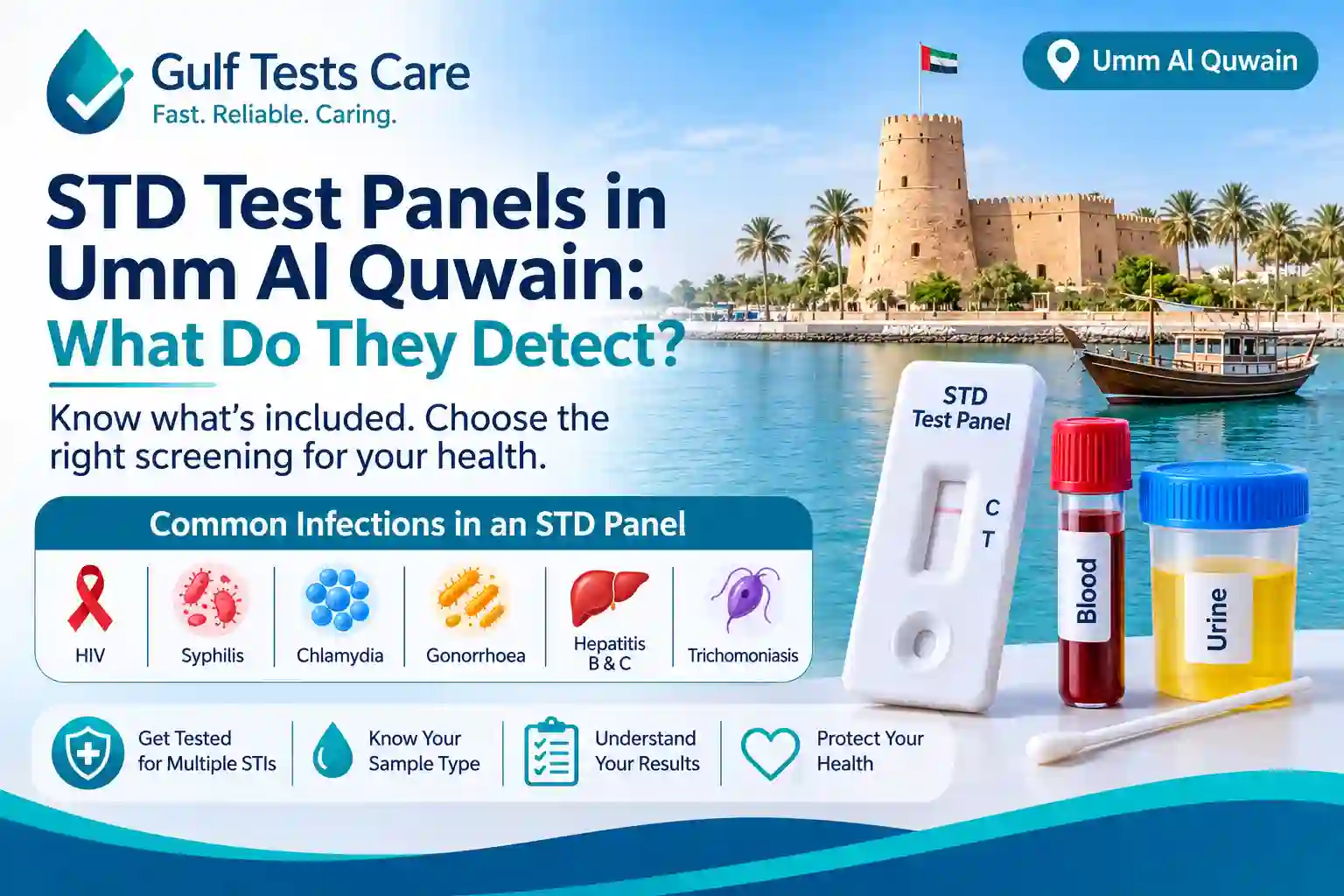
Sexually transmitted diseases (STDs), also called sexually transmitted infections (STIs), can affect people of different ages and backgrounds. Some infections cause noticeable symptoms, while others may remain undetected for months or even years.
An STD test panel can help screen for multiple infections, but not every panel checks for the same conditions. Some tests detect infections through blood samples, while others require urine samples or swabs from specific body sites.
If you are searching for STD testing in Umm Al Quwain, this guide explains what common STD test panels may include, how different infections are detected, which samples may be required and how to understand your results.
An STD test panel is a group of tests designed to screen for more than one sexually transmitted infection.
Depending on the laboratory or test package, a panel may include tests for:
HIV.
Syphilis.
Chlamydia.
Gonorrhoea.
Hepatitis B.
Hepatitis C.
Trichomoniasis.
Other infections when clinically appropriate.
The exact infections included depend on the provider and the selected package.
For example, a basic screening panel may include HIV, syphilis, chlamydia and gonorrhoea, while a more extensive panel may include hepatitis testing or additional infections.
Important: The term "full STD panel" does not have one universal definition. Always check the individual infections and testing methods included before choosing a panel.
Different infections require different tests. Understanding what each test detects can help you choose an appropriate screening option.
HIV is a virus that affects the immune system. It can be transmitted through certain body fluids, including blood, semen, vaginal fluids and rectal fluids.
HIV testing may involve:
Antigen/antibody combination tests.
Antibody tests.
Nucleic acid tests (NAT).
A laboratory fourth-generation antigen/antibody test detects HIV antibodies and the p24 antigen.
The appropriate testing time depends on the test type. A negative result taken during the window period may need repeating.
A reactive screening result requires follow-up diagnostic testing. It should not be treated as a confirmed diagnosis by itself.
You can learn more about HIV testing through our HIV Ab/Ag 4th Gen Rapid Test product information.
Syphilis is a bacterial infection caused by Treponema pallidum.
It can cause symptoms such as painless sores, skin rashes and swollen lymph nodes, although symptoms may be mild or go unnoticed.
Syphilis is commonly investigated through blood tests that look for antibodies associated with infection.
Diagnosis generally requires appropriate interpretation of both treponemal and non-treponemal tests. A single screening result may not be enough to establish whether an infection is active or previously treated.
Learn more about the Syphilis Test Cassette.
Chlamydia is a common bacterial STI caused by Chlamydia trachomatis.
Many people do not experience symptoms. When symptoms occur, they may include:
Pain or burning during urination.
Unusual genital discharge.
Pelvic or lower abdominal discomfort.
Testicular pain.
Rectal discomfort or discharge.
Chlamydia is commonly detected using a nucleic acid amplification test (NAAT).
Depending on the exposure and anatomy, samples may include:
First-catch urine.
Vaginal swabs.
Cervical swabs.
Rectal swabs.
Throat swabs in selected circumstances.
A urine test alone may not detect an infection at the throat or rectum. The sample site should reflect the possible exposure.
Gonorrhoea is a bacterial infection caused by Neisseria gonorrhoeae.
Possible symptoms include:
Painful urination.
Genital discharge.
Pelvic discomfort.
Testicular pain.
Rectal pain or discharge.
Throat discomfort in some cases.
However, many infections produce no symptoms.
Gonorrhoea is commonly detected through NAAT testing using urine or swab samples. Testing may be needed at the genital, throat or rectal site depending on the type of exposure.
A healthcare professional may recommend a culture and antibiotic susceptibility testing in selected situations, such as suspected treatment failure.
You can review the Chlamydia/Gonorrhea Combo Test Cassette product information.
Hepatitis B is a viral infection that affects the liver. It can spread through infected blood and certain body fluids.
Some people develop chronic infection without noticeable symptoms.
Hepatitis B screening may involve several blood markers:
HBsAg.
Anti-HBs.
Total anti-HBc.
These markers help healthcare professionals assess whether someone has a current infection, previous infection or immunity.
An HBsAg screening test checks for one specific marker. It does not replace a complete hepatitis B assessment.
See the Hepatitis B (HBV) Test Cassette product information.
Hepatitis C is a viral infection that primarily spreads through infected blood.
The initial screening test commonly checks for HCV antibodies. If the result is reactive, an HCV RNA test is generally required to determine whether the virus is currently present.
A reactive antibody result alone does not prove an active infection.
You can explore the Hepatitis C (HCV) Test Cassette product information.
One of the most important things to understand before selecting an STD panel is that different infections require different sample types.
| Infection | Common testing method | Possible sample |
|---|---|---|
| HIV | Antigen/antibody test or NAT | Blood |
| Syphilis | Serological testing | Blood |
| Chlamydia | NAAT | Urine or swab |
| Gonorrhoea | NAAT | Urine or swab |
| Hepatitis B | Blood-marker testing | Blood |
| Hepatitis C | Antibody test followed by RNA testing when reactive | Blood |
| Trichomoniasis | NAAT or other appropriate test | Vaginal swab or urine, depending on the test |
The exact sample requirements depend on the specific laboratory method and manufacturer's instructions.
A panel that uses only a blood sample may not include chlamydia or gonorrhoea testing. Likewise, a urine-based test may not assess HIV, syphilis or hepatitis.
This is why it is important to review the test list rather than relying only on the panel name.
Not every screening package covers the same infections.
The following table shows examples of how panels may differ. It is not a universal standard, and actual package contents must be checked with the provider.
| Screening category | Possible infections included |
|---|---|
| Basic screening | HIV and syphilis |
| Common bacterial STI screening | Chlamydia and gonorrhoea |
| Expanded screening | HIV, syphilis, chlamydia and gonorrhoea |
| Additional viral screening | Hepatitis B and hepatitis C |
| Further testing when indicated | Trichomoniasis, herpes or other infections |
A larger panel is not automatically better for every person.
The most suitable screening plan depends on your symptoms, exposure history, age, anatomy, medical history and the time since possible exposure.
Testing may be appropriate in several situations.
If you have had sexual contact that may have exposed you to an STI, a healthcare professional can recommend appropriate testing.
The timing differs between infections. Testing immediately after exposure may be too early to detect some infections.
Some people choose to discuss STI screening with a new partner before becoming sexually active.
The appropriate tests depend on both partners' health histories and possible exposures.
Symptoms such as unusual discharge, genital sores, painful urination, pelvic discomfort or unexplained rashes should be assessed by a healthcare professional.
Do not rely only on a home test if you have symptoms that need clinical evaluation.
Some infections can be present without symptoms. Screening may be recommended based on age, pregnancy, sexual history and individual risk factors.
The CDC provides specific screening recommendations for different populations. Testing frequency should be discussed with a qualified healthcare professional.
Yes. Many sexually transmitted infections can be asymptomatic.
For example:
Chlamydia may cause no noticeable symptoms.
Gonorrhoea may remain unnoticed, particularly at the throat or rectum.
HIV may not cause noticeable symptoms during early infection.
Hepatitis B and C can remain undetected for long periods.
Syphilis symptoms may disappear even when infection remains present.
Not having symptoms does not necessarily mean that you do not have an STI.
Testing based on appropriate screening recommendations can help identify infections that might otherwise go unnoticed.
The reliability of an STD test depends on several factors:
The specific infection being tested.
The type of test used.
The sample collected.
The time since possible exposure.
The quality and validation of the test.
Whether the manufacturer's procedure was followed correctly.
For example, a laboratory NAAT is commonly used to detect chlamydia and gonorrhoea, while HIV screening uses different methods.
A negative result may not rule out an infection if testing occurred too early or the wrong body site was sampled.
A reactive screening result may also require additional testing.
For accurate interpretation, discuss your results with a qualified healthcare professional.
Both test kits and laboratory panels can be used in STI screening, but they are not necessarily designed for the same purpose.
Some rapid test kits detect a specific infection marker and provide results within a relatively short time.
However, a rapid kit may test for only one infection or one marker.
Before choosing a kit, check:
Which infection it detects.
Which marker it identifies.
The required sample type.
Whether it is intended for professional use or self-testing.
The manufacturer's instructions.
Whether a reactive result requires laboratory follow-up.
Laboratory panels may combine several different testing methods, including blood tests and NAAT testing using urine or swabs.
They may provide broader screening, but the exact infections included depend on the selected package.
A laboratory panel may be more appropriate when multiple infections need to be assessed or when clinical confirmation is required.
If you are comparing STD test kits in Umm Al Quwain or elsewhere in the UAE, start by identifying which infections you want to screen for.
Gulf Tests Care provides product information for several screening products:
Chlamydia/Gonorrhea Combo Test Cassette
Before selecting any product, read its description and manufacturer's instructions to confirm its intended use, sample requirements and the specific marker it detects.
A product labelled as a multi-panel test should not be assumed to include every major STI. Check the individual analytes listed by the manufacturer.
A reactive screening result should be followed up appropriately.
The next step depends on the infection and the type of test.
HIV: Arrange follow-up diagnostic testing. A reactive screening result is not a confirmed diagnosis.
Syphilis: Further serological testing and clinical assessment may be needed.
Chlamydia or gonorrhoea: Follow the recommended diagnostic and treatment pathway.
Hepatitis B: Additional markers may be needed to understand the infection status.
Hepatitis C: HCV RNA testing is generally needed after a reactive antibody result to identify current infection.
Do not start antibiotics or other prescription medicines without appropriate medical advice.
If an infection is confirmed, a healthcare professional can explain treatment, partner notification where appropriate, and whether repeat testing is recommended.
People in Umm Al Quwain may consider STI screening for routine health checks, after possible exposure, before a new relationship or following medical advice.
Understanding what a test panel includes can help avoid incomplete screening.
For example, a blood-based panel may not include chlamydia or gonorrhoea testing, while a urine-only panel may not include HIV or syphilis.
The right screening plan should consider the possible exposure sites and the infections that need to be assessed.
Early identification can help people access appropriate treatment, reduce the risk of complications and take informed steps to protect their health.
There is no single universal definition of a full STD panel. Some packages include HIV, syphilis, chlamydia and gonorrhoea, while others also include hepatitis B, hepatitis C or additional infections. Always check the exact test list.
Some STD panels include HIV testing, but not all do. Confirm whether the selected package includes an HIV antigen/antibody test or another appropriate HIV test.
Yes, some panels include both infections. They are commonly detected using NAAT testing with urine or swab samples. The correct sample site depends on the possible exposure.
It depends on the infection. HIV, syphilis and hepatitis screening commonly use blood, while chlamydia and gonorrhoea testing often uses urine or swabs. Some screening plans require more than one sample type.
Yes. Many sexually transmitted infections do not cause noticeable symptoms. Screening may be recommended even when you feel healthy.
Performance varies by product and infection. Some rapid tests are useful for specific screening purposes, while laboratory tests may use different methods or provide additional information. Follow the product instructions and clinical guidance.
Not necessarily. A negative result only applies to the infections, markers, sample sites and testing time covered by the tests performed. Additional screening may be needed.
Repeat testing depends on the infection, the test's window period, possible new exposures and whether treatment was given. A healthcare professional can recommend the correct schedule.
Yes, seek medical advice promptly. Your healthcare professional can recommend testing, preventive treatment or other steps based on the infection and type of exposure.
An STD test panel can be a useful way to screen for multiple sexually transmitted infections, but understanding what it includes is essential.
HIV, syphilis, hepatitis B and hepatitis C commonly require blood-based testing. Chlamydia and gonorrhoea commonly require urine or swab-based NAAT testing. Some people may need additional samples from the throat or rectum depending on their exposure history.
If you are searching for STD test panels in Umm Al Quwain, compare the specific infections included, sample requirements and intended use of each test. Do not assume that one panel detects every STI.
For symptoms, recent exposure, reactive results or questions about the correct testing schedule, consult a qualified healthcare professional.
Medical disclaimer: This article is for general educational purposes only. It does not replace professional medical advice, diagnosis or treatment. Test performance and intended use vary by product. Always follow the manufacturer's instructions and applicable clinical guidance.
Order your discreet test kit today with fast delivery across the UAE.
Shop Now