0
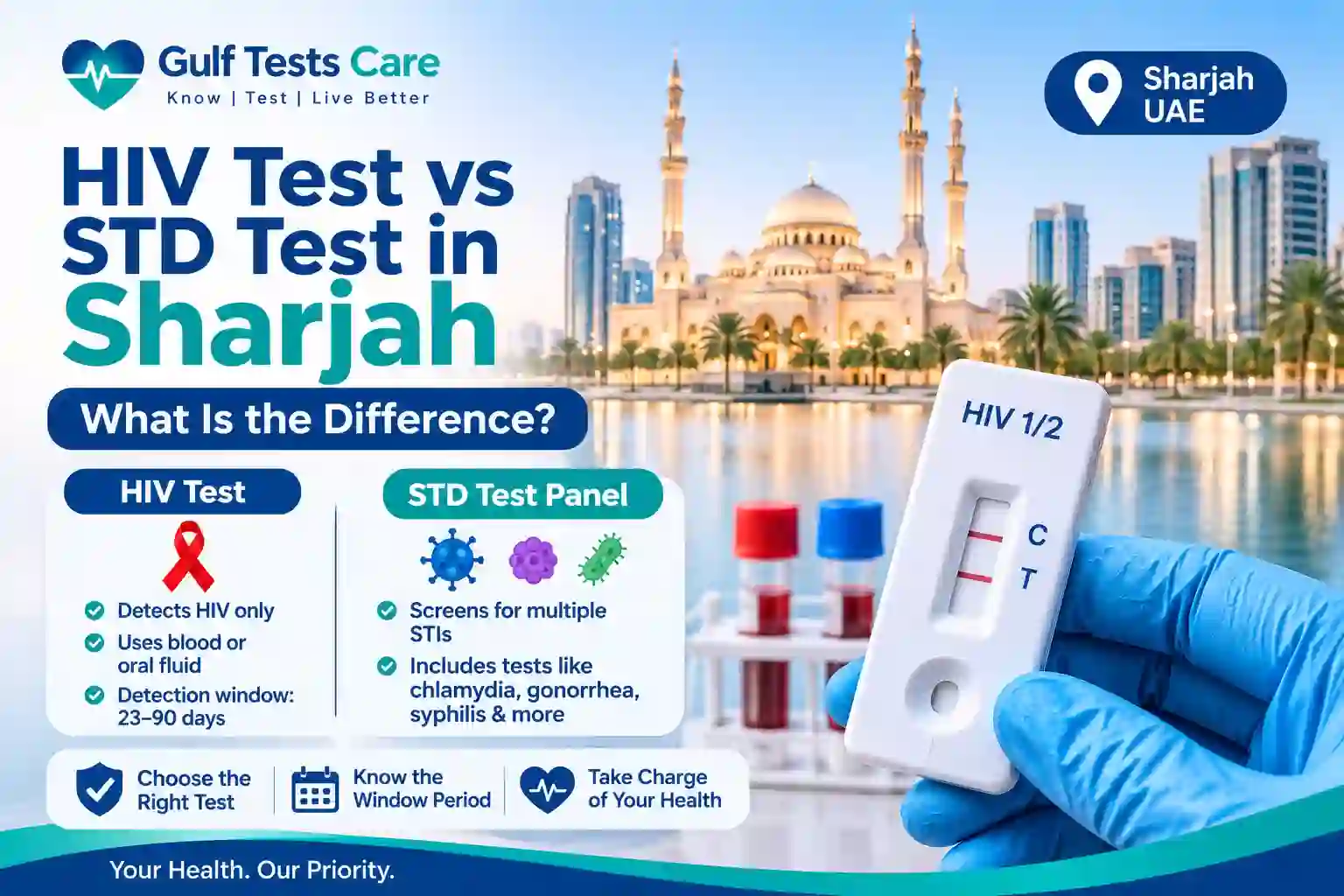
When researching sexual health testing, you may see terms such as HIV test, STD test, STI screening and STD test panel. Although these terms are related, they do not all mean the same thing.
An HIV test specifically checks for HIV infection. A broader sexually transmitted infection (STI) screening may check for several infections, such as chlamydia, gonorrhea and syphilis, depending on the tests included.
If you are looking for information about HIV and STD testing in Sharjah, understanding these differences can help you choose appropriate tests and avoid assuming that one test checks for every infection.
This guide explains what HIV tests detect, how STI screening works, which samples may be required and what to consider before choosing a test kit.
HIV testing and broader STD or STI testing are different types of screening.
An HIV test looks specifically for evidence of human immunodeficiency virus (HIV). Depending on the test, it may detect HIV antibodies, the p24 antigen or the virus's genetic material.
An STD or STI test checks for one or more sexually transmitted infections. The infections included depend on the particular test or screening panel.
For example, an STI screening appointment may include tests for:
HIV
Syphilis
Chlamydia
Gonorrhea
Hepatitis B
Hepatitis C
Other infections when clinically appropriate
Not every screening panel includes all these infections.
The terms STD and STI are often used interchangeably. STI refers to an infection, which may not cause symptoms, while STD generally refers to disease associated with an infection.
HIV tests are designed to identify specific markers associated with HIV infection.
There are three main testing approaches.
These tests detect antibodies produced by the immune system in response to HIV.
Depending on the product, an antibody test may use:
Finger-prick blood
Venous blood
Oral fluid
Many rapid HIV tests and self-tests are antibody tests.
Fourth-generation tests detect both:
HIV-1/2 antibodies
The p24 antigen
Laboratory fourth-generation tests using blood collected from a vein can generally detect HIV earlier than antibody-only tests.
Rapid antigen/antibody tests using finger-prick blood may have a different detection window. The exact product instructions and sample type matter.
NAT tests detect HIV genetic material in the blood.
They can generally detect HIV earlier than antibody and antigen/antibody tests. A healthcare professional may recommend NAT in certain situations involving recent possible exposure or suspected early infection.
An STI panel is a group of tests designed to screen for multiple infections.
However, there is no single universal STD panel. The infections included depend on the product, laboratory or healthcare provider.
Here are some common examples.
Chlamydia is a bacterial infection that can affect the genital tract and other anatomical sites.
Many people do not experience symptoms.
Testing commonly uses a urine sample or a swab from the relevant anatomical site, depending on the person's exposure and the testing method.
Gonorrhea is another bacterial STI. It can affect the genital tract, rectum and throat.
Testing may use urine or a swab. A throat or rectal sample may be needed depending on the site of exposure.
Syphilis is a bacterial infection that can progress through different stages.
Blood tests are commonly used to help identify syphilis infection. Diagnosis may require more than one type of blood test and interpretation by a healthcare professional.
Hepatitis B and C are viral infections that affect the liver. Some transmission routes are not sexual, but both may be relevant when assessing certain exposure risks.
Different blood tests are used to screen for or diagnose these infections. Hepatitis B testing may involve several markers, while hepatitis C screening often begins with an antibody test followed by an RNA test when indicated.
HIV requires a specific HIV screening test. A general STI panel should not be assumed to include HIV unless it explicitly lists HIV testing.
| Feature | HIV test | STD/STI panel |
|---|---|---|
| Main purpose | Detect HIV infection | Screen for selected STIs |
| Number of infections | HIV specifically | One or multiple infections |
| Common sample | Blood or oral fluid, depending on test | Blood, urine or swabs |
| Detection window | Depends on HIV test type | Different for each infection and test |
| Result | HIV-specific result | Separate result for each infection tested |
| Follow-up | Confirmatory HIV testing when indicated | Infection-specific follow-up and treatment |
The most important point is that an HIV test does not automatically check for chlamydia, gonorrhea or syphilis. Similarly, a panel that checks for several bacterial STIs may not include HIV.
Always review the exact list of infections covered before selecting a test.
Different infections require different sample types.
A healthcare professional may recommend one or more of the following:
Blood sample: Commonly used for HIV, syphilis and hepatitis testing.
Urine sample: Often used for chlamydia and gonorrhea testing, depending on the test.
Swab sample: May be collected from the genital area, throat or rectum depending on the person's exposure and the infection being investigated.
A single sample does not necessarily detect every STI.
For example, a urine test may not identify an infection in the throat or rectum. Tell your healthcare professional about the sites of possible exposure so the appropriate samples can be selected.
The right time depends on the infection, the test method and the time since possible exposure.
For HIV, the CDC provides these usual detection windows:
| HIV test type | Usual detection window |
|---|---|
| Nucleic acid test (NAT) | 10–33 days |
| Laboratory antigen/antibody test using venous blood | 18–45 days |
| Rapid antigen/antibody test using finger-prick blood | 18–90 days |
| Antibody test, including most self-tests | 23–90 days |
These are general ranges. The specific product instructions and individual circumstances should guide testing.
Other STIs have different testing windows. There is no single waiting period that applies to every infection.
If you have symptoms or believe you may have been exposed, seek medical advice rather than delaying care simply to wait for a screening window.
If an HIV test is negative before its full window period has passed, repeat testing may be needed.
Yes. Many sexually transmitted infections can occur without noticeable symptoms.
A person may feel healthy while having an infection that can still be transmitted to another person.
Possible symptoms of some STIs include:
Unusual genital discharge
Pain or burning during urination
Genital sores or blisters
Unusual bleeding
Pelvic or lower abdominal pain
Testicular discomfort
Skin rashes
These symptoms are not specific to one infection. Some non-STI conditions can cause similar symptoms.
Do not rely on symptoms alone to decide whether you need testing. A healthcare professional can recommend screening based on your circumstances.
If you are comparing HIV or STD test kits in Sharjah, first identify which infection you want to test for.
Consider these factors before selecting a product:
1. Infection covered
Check the exact list of infections the test detects. A product labelled as an STD panel may not include every STI.
2. Testing method
Check whether the test uses an antibody, antigen/antibody, molecular or other method.
3. Sample requirement
Confirm whether it requires blood, urine, oral fluid or a swab.
4. Intended use
Check whether the manufacturer identifies the product as a professional-use test or a self-test. Not every rapid test cassette is suitable for home use.
5. Detection window
Review the manufacturer's information about when the test can detect infection.
6. Instructions and storage
Check the expiry date, storage conditions, sample collection instructions and result-reading time.
7. Follow-up requirements
Understand what to do if the result is reactive, positive, invalid or inconclusive.
For people comparing products, Gulf Tests Care provides information about several testing options:
Chlamydia and Gonorrhea Combo Test Cassette
Complete Gulf Tests Care product catalogue
Review each product's specifications and intended use carefully. A product should only be used for the infections and sample types stated in its manufacturer's instructions.
The next step depends on the infection and the type of test.
If an HIV screening test is reactive, follow-up diagnostic testing is necessary. A reactive screening result alone does not establish a confirmed HIV diagnosis.
For other infections, a healthcare professional may recommend:
Confirmatory or additional testing
Prescription treatment when indicated
Testing for other infections
Advice about sexual partners
Follow-up testing after treatment
Do not start prescription antibiotics or other medication based only on an unconfirmed screening result.
If an STI is diagnosed, follow professional advice about treatment and when it is appropriate to resume sexual activity.
If you think you may have been exposed to HIV within the past 72 hours, seek urgent medical advice about post-exposure prophylaxis (PEP).
PEP is medication that may help prevent HIV infection after a possible exposure.
Important points:
Start as soon as possible.
It must be started no later than 72 hours after exposure.
It is generally taken for 28 days.
A healthcare professional must assess whether it is appropriate.
Do not wait for symptoms or a test result before seeking urgent advice about PEP.
No. An HIV test specifically checks for HIV. An STD or STI panel may check for several other infections, depending on the tests included.
Not necessarily. Some panels include HIV, while others only test for selected bacterial infections. Always check the list of infections covered.
No. Different infections require different testing methods and samples. A complete screening plan may involve blood, urine and swab tests.
That depends on your exposure, symptoms and individual circumstances. A healthcare professional can help determine which tests are appropriate.
Yes. Several STIs can be asymptomatic. Testing may be recommended even when you feel healthy.
No. A rapid HIV test checks for HIV markers only. It does not automatically test for chlamydia, gonorrhea, syphilis or other infections.
You can compare test types and product specifications through the Gulf Tests Care website. For clinical diagnosis, testing advice and treatment, consult a qualified healthcare provider.
HIV testing and broader STD screening serve different purposes. An HIV test checks specifically for HIV, while an STI panel may cover several infections depending on its contents.
If you are researching HIV and STD testing in Sharjah, identify which infections you need to test for, check the required sample types and understand the detection windows.
Choosing the right test is more important than simply choosing a product labelled as a rapid test or an STD panel. If you have symptoms, a recent possible exposure or a reactive result, seek advice from a qualified healthcare professional.
Medical disclaimer: This article is for general educational purposes only and is not a substitute for professional medical advice, diagnosis or treatment. Test selection, timing and interpretation should be based on the specific infection, test instructions and individual circumstances.
Order your discreet test kit today with fast delivery across the UAE.
Shop Now