0
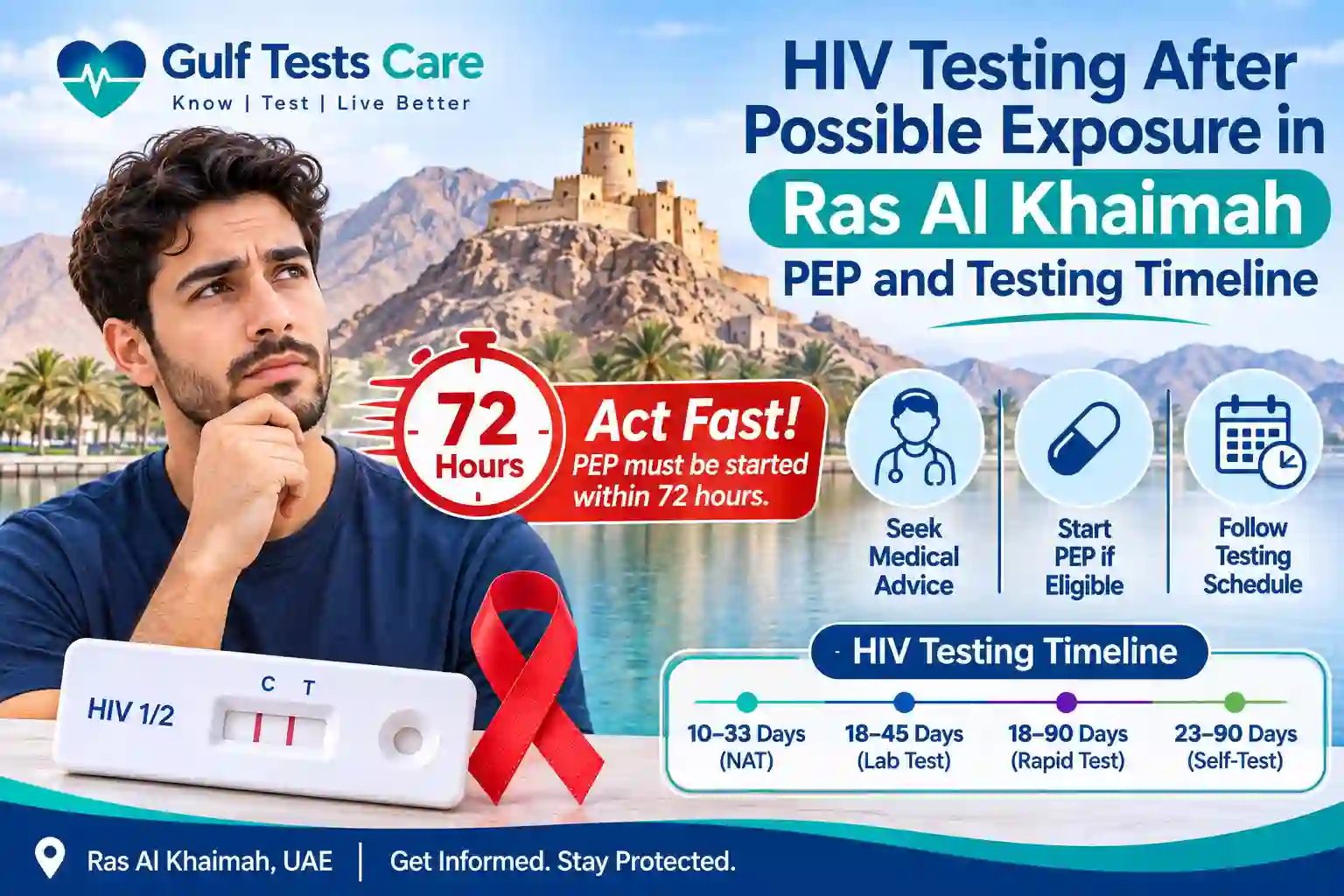
If you think you may have been exposed to HIV, knowing what to do next can make a significant difference. One of the most important things to understand is that HIV testing immediately after exposure cannot rule out infection from that event. There is also an emergency prevention option called post-exposure prophylaxis (PEP), which must be started within a limited time.
If you are searching for HIV testing after possible exposure in Ras Al Khaimah, this guide explains when to seek medical help, how PEP works, when different HIV tests can detect infection and why follow-up testing matters.
If you think a recent event may have exposed you to HIV, take the following steps:
Seek medical assessment immediately. Do not wait for symptoms or a test result.
Ask about PEP if the exposure occurred within the past 72 hours. A healthcare professional can assess whether it is appropriate.
Discuss baseline HIV testing. An initial test can help establish your HIV status before or when PEP is started.
Follow the recommended testing schedule. A test taken too early may not detect a recent infection.
Discuss other STI testing if relevant. Depending on the exposure, screening for other sexually transmitted infections may also be recommended.
The most urgent point is the 72-hour PEP window. If you are within this period, seek urgent medical care now.
PEP stands for post-exposure prophylaxis. It is a course of prescription HIV medicines used after a possible exposure to help prevent HIV infection.
PEP is an emergency prevention option, not a routine HIV treatment or a substitute for regular prevention methods.
A healthcare professional may consider PEP after certain exposures involving potentially infectious body fluids, including:
Condom failure during sex where there may have been a significant HIV exposure.
Sexual contact involving a partner known to have HIV without sustained viral suppression.
Sharing needles or injection equipment.
Sexual assault involving a possible HIV exposure.
Occupational exposure, such as a needlestick injury.
Not every possible contact with another person requires PEP. A clinician needs to assess the type of exposure, the body fluids involved, the source's HIV status when known, and other relevant factors.
PEP must be started as soon as possible after a qualifying exposure, ideally within 24 hours and no later than 72 hours.
<text weight="semibold" color="danger">Do not wait until the last day of the 72-hour window.</text>
The sooner PEP is started, the better. If a healthcare professional considers PEP appropriate, the first dose should not be delayed while waiting for laboratory test results.
After assessment, the recommended course is generally 28 days. It is important to take the medication exactly as prescribed and attend follow-up appointments.
If more than 72 hours have passed, PEP is generally not recommended under current CDC guidance. However, you should still seek medical advice about HIV testing, other possible health concerns and future prevention options.
Choosing the right testing time is essential because every HIV test has a window period.
The window period is the time between possible exposure and the point when a particular test can reliably detect HIV.
According to the US Centers for Disease Control and Prevention (CDC), typical detection windows are:
| HIV test type | Typical detection window |
|---|---|
| Nucleic acid test (NAT) | 10–33 days |
| Laboratory antigen/antibody test using blood from a vein | 18–45 days |
| Rapid antigen/antibody test using finger-prick blood | 18–90 days |
| Antibody test, including most self-tests | 23–90 days |
These ranges apply to people who have not taken antiretroviral medication that may affect detection. PEP and PrEP can change the recommended testing schedule, so people who have used these medicines need clinician-guided follow-up.
A baseline HIV test may be recommended when you first seek care. It can identify an infection that existed before the recent event.
However, a negative baseline result cannot rule out infection from an exposure that happened only hours or days earlier.
If PEP is indicated, do not delay starting it while waiting for the baseline result.
A NAT may detect HIV earlier than some other tests. A healthcare professional may consider it when there has been a recent possible exposure or when acute HIV infection is suspected.
A negative result during an early detection window may still require further testing.
A laboratory antigen/antibody test using blood from a vein generally has a detection window of 18–45 days.
A negative result before the full window has passed may need repeating. The appropriate timing depends on the exposure date, test type and whether PEP or PrEP was used.
If you have taken PEP, do not rely only on the standard window period for someone who has not used medication.
Current CDC PEP guidance recommends follow-up testing using a laboratory antigen/antibody test together with a diagnostic NAT. The clinician will determine the appropriate interim and final testing dates. The CDC's 2025 recommendations include final follow-up testing at 12 weeks after exposure.
A healthcare professional will review the exposure and decide whether PEP is appropriate.
The assessment may include:
When the possible exposure occurred.
The type of contact and body fluids involved.
Whether the source is known to have HIV, if that information is available.
Your existing HIV status and relevant medical history.
Current medications, allergies and possible interactions.
Baseline HIV testing and other recommended laboratory tests.
Screening for other STIs or infections when appropriate.
The clinician will explain the medication schedule, possible side effects, follow-up appointments and testing requirements.
Do not use someone else's HIV medication or attempt to create a PEP regimen yourself. PEP requires professional assessment and prescription.
HIV self-tests can be useful in appropriate circumstances, but they are not a substitute for urgent medical assessment after a recent possible exposure.
Most HIV self-tests are antibody tests. The typical antibody-test detection window is 23–90 days.
This means a negative self-test shortly after exposure may not detect a recent infection. It also cannot determine whether PEP is appropriate.
If the possible exposure occurred within the past 72 hours, seek urgent medical care first. A healthcare professional can recommend baseline testing, PEP and the appropriate follow-up schedule.
Also check the intended use of any HIV test kit. Some rapid tests are designed for professional use, while others are specifically intended for self-testing. These products should not be treated as interchangeable.
A negative or non-reactive result means the test did not detect the markers it was designed to identify at the time the sample was collected.
However, the meaning of a negative result depends on timing.
Consider these situations:
Negative baseline test: It may help establish your status before or at the start of PEP, but it cannot rule out infection from a very recent exposure.
Negative test during the window period: Repeat testing may be needed after the recommended period.
Negative result after PEP: Follow the specific PEP follow-up schedule. Medication may affect the timing and interpretation of tests.
If you have further exposure after the original event, tell your healthcare professional because the testing timeline may need to be adjusted.
A reactive screening result does not automatically mean that you have HIV.
It means the test has detected a marker that requires further evaluation. Follow-up diagnostic testing is necessary to establish whether HIV infection is present.
If a rapid test or self-test is reactive, arrange confirmatory testing through an appropriate healthcare service. Do not make a diagnosis based on a screening result alone.
Depending on the type of exposure, a healthcare professional may recommend screening for other sexually transmitted infections.
These can include:
Syphilis.
Chlamydia.
Gonorrhoea.
Hepatitis B.
Hepatitis C.
Different infections require different testing methods. Some tests use blood, while others require urine samples or swabs from specific body sites.
An HIV test does not automatically screen for other STIs. A negative HIV result also does not mean that you are negative for every other sexually transmitted infection.
You can explore relevant products and review their intended use and manufacturer instructions:
Chlamydia/Gonorrhea Combo Test Cassette
These product links are for information only. A product's availability or description does not establish that it is suitable for diagnosing a recent exposure or replacing clinical assessment.
If you are in Ras Al Khaimah and are concerned about a possible HIV exposure, the priority is to obtain timely medical advice.
If the exposure occurred within the past 72 hours, seek urgent medical assessment for PEP. Do not wait for a home test, symptoms or an appointment scheduled weeks later.
If more time has passed, a healthcare professional can help you choose the appropriate HIV test and plan follow-up based on the exposure date and any medication used.
For people who may experience repeated HIV exposure, it may also be worth discussing pre-exposure prophylaxis (PrEP), a preventive medication taken before potential future exposure.
You can seek medical assessment and baseline testing immediately. However, an immediate negative result cannot rule out infection from the recent exposure. The appropriate follow-up date depends on the test type and whether PEP or PrEP has been used.
PEP is generally recommended to start as soon as possible and no later than 72 hours after a qualifying exposure. If more than 72 hours have passed, consult a healthcare professional about HIV testing and other prevention options.
The usual recommended PEP course is 28 days. Take it exactly as prescribed and complete the course unless your healthcare professional advises otherwise.
A laboratory fourth-generation antigen/antibody test may detect some infections early, but its typical detection window is 18–45 days. A negative result at 14 days cannot rule out infection.
Not necessarily. PEP can affect the timing and interpretation of HIV tests. Current guidance recommends a clinician-directed follow-up schedule, which may include both a laboratory antigen/antibody test and a NAT.
A home self-test may be useful in appropriate circumstances, but most self-tests are antibody tests with a typical detection window of 23–90 days. A negative result shortly after exposure cannot rule out infection, and a self-test does not replace urgent PEP assessment.
No. PEP is intended to reduce the risk of HIV infection after a qualifying exposure. It does not prevent other STIs, so additional testing or treatment may be recommended.
A healthcare professional can assess the type of exposure and decide whether PEP is appropriate. Do not assume that PEP is unnecessary simply because the other person's status is unknown.
After a possible HIV exposure, knowing the right next step is more important than taking a test at the wrong time.
Remember three key points:
Within 72 hours: Seek urgent medical assessment for PEP.
During the window period: A negative HIV test may not rule out infection.
After PEP: Follow the recommended clinical testing schedule, including any required laboratory antigen/antibody and NAT tests.
If you are researching HIV testing after possible exposure in Ras Al Khaimah, use reliable medical guidance, check the intended use of any test kit and consult a qualified healthcare professional about your individual circumstances.
Medical disclaimer: This article is for general educational purposes only. It does not replace professional medical advice, diagnosis or treatment. PEP requires prompt clinical assessment and prescription. Testing recommendations may vary depending on the exposure, medication use and local clinical guidance.
Order your discreet test kit today with fast delivery across the UAE.
Shop Now