0
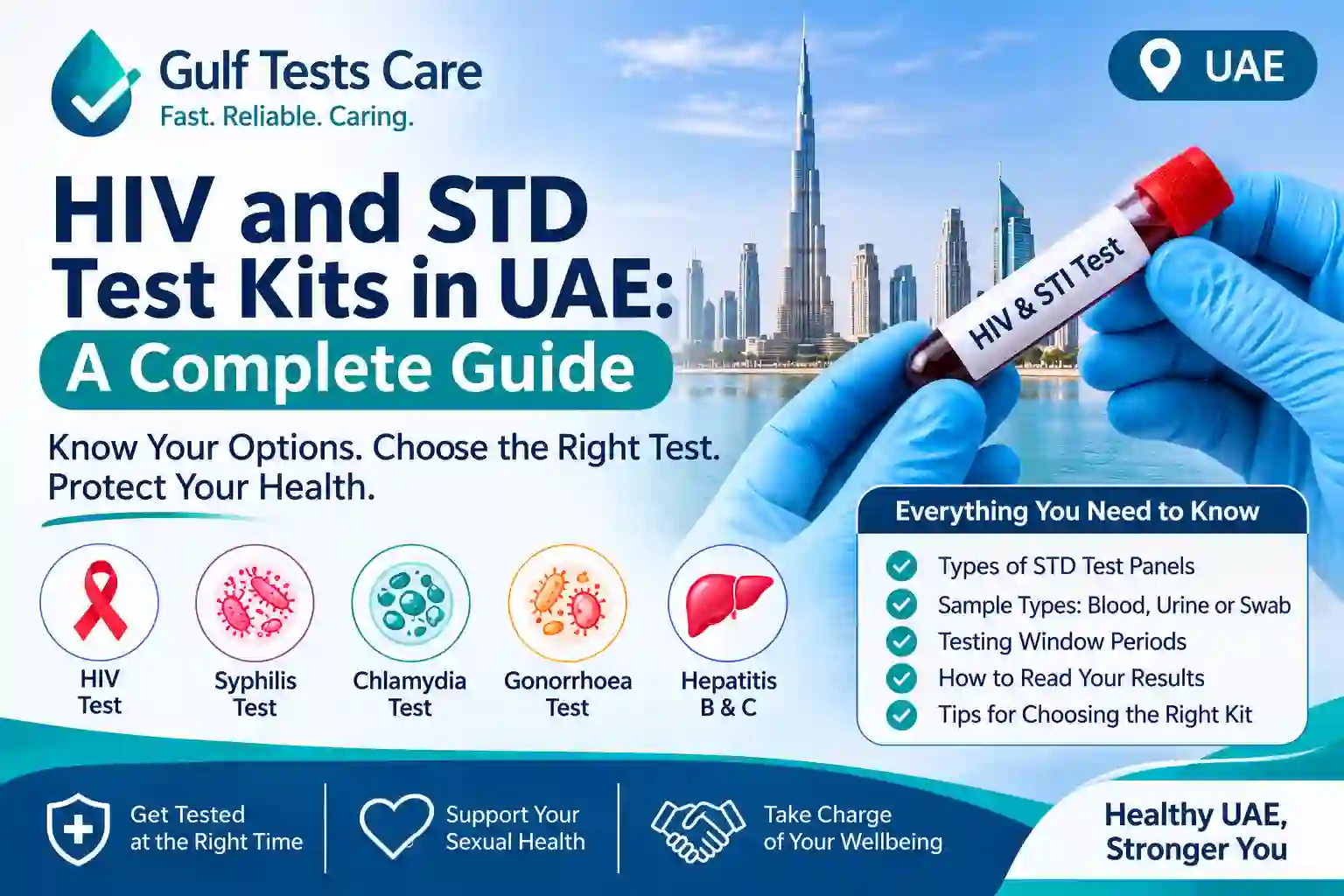
Choosing an HIV or sexually transmitted infection (STI) test can feel confusing when there are different test types, sample requirements and detection periods to consider. Whether you are researching HIV testing in Dubai, comparing STI screening options in Abu Dhabi, or looking for information about test kits in Sharjah, Ajman, Ras Al Khaimah, Fujairah or Umm Al Quwain, understanding how each test works can help you make a more informed decision.
HIV tests and broader STD or STI tests do not all detect the same infections. Some use a blood sample, while others require urine or a swab. Certain rapid tests provide results within minutes, whereas laboratory tests may offer different testing methods and detection windows.
This guide explains the main types of HIV and STI tests, how to choose an appropriate test kit, what to know about testing windows and how to understand your results.
HIV is one specific infection. STD and STI testing is a broader term that can include screening for several sexually transmitted infections.
An HIV test checks for evidence of HIV infection. Depending on the test, it may detect HIV antibodies, the p24 antigen, or the virus itself.
An STI screening programme may include tests for infections such as:
HIV
Syphilis
Chlamydia
Gonorrhoea
Hepatitis B
Hepatitis C
Trichomoniasis
Not every screening panel includes all these infections. The exact tests included depend on the panel, the test method and the healthcare professional's assessment.
Important: A negative HIV result does not mean that you are negative for every other STI. If you need broader screening, check which infections are included and whether additional tests are required.
HIV tests use different methods to identify signs of infection. Understanding these differences is important before selecting a test.
Antibody tests detect antibodies produced by the immune system in response to HIV.
Many rapid HIV tests and self-tests are antibody-based. Depending on the product, they may use a small blood sample or oral fluid.
Most antibody tests can usually detect HIV approximately 23 to 90 days after exposure. A negative result obtained before the end of the test's window period may need to be repeated.
Fourth-generation HIV tests detect both HIV antibodies and the p24 antigen.
The p24 antigen can become detectable before the body has produced enough antibodies for some antibody-only tests. This makes fourth-generation testing an important option in HIV screening.
However, the detection window depends on the test format:
A laboratory antigen/antibody test using blood from a vein can usually detect HIV 18 to 45 days after exposure.
A rapid antigen/antibody test using finger-prick blood can usually detect HIV 18 to 90 days after exposure.
Do not assume that every fourth-generation test has the same detection window. Always check whether the product is a laboratory test or a rapid finger-prick test.
You can explore the HIV Ab/Ag 4th Generation Rapid Test and the ELISA HIV Test Kit 4th Generation to understand the different product formats. Check each product's intended use and instructions before selecting it.
Some HIV screening tests are designed to detect antibodies to HIV-1 and HIV-2. Others detect HIV antigens as well as antibodies.
The product name alone does not tell you every detail of its testing capability. Review the manufacturer's instructions to confirm which markers the test detects, the sample required and whether it is intended for professional or self-testing use.
For example, you can review the HIV 1/2 Combo Test Cassette ELISA.
One of the most important factors when choosing an HIV test is its window period.
The window period is the time between a possible exposure and the point when a particular test can reliably detect infection. Testing too early may produce a negative result even when infection has occurred.
The following are general CDC detection windows:
| HIV test type | Usual detection window |
|---|---|
| NAT (nucleic acid test) | 10–33 days |
| Laboratory antigen/antibody test using venous blood | 18–45 days |
| Rapid antigen/antibody test using finger-prick blood | 18–90 days |
| Antibody test, including most self-tests | 23–90 days |
These are general ranges, not guarantees for every product or individual.
If your result is negative but the test was performed before the end of its window period, repeat testing may be necessary. Follow the instructions for the exact test used and seek professional advice if you are unsure about the timing.
People taking HIV prevention or treatment medicines, including PEP or PrEP, may need a different testing schedule.
An STI test kit is not necessarily a test for every sexually transmitted infection. Different tests are designed to detect different organisms or infection markers.
Common examples include:
Syphilis is a bacterial infection that can affect different parts of the body. Blood tests are commonly used to look for antibodies associated with syphilis.
A reactive screening result needs appropriate clinical assessment and, where indicated, additional testing. Interpretation may depend on previous infection and treatment history.
Explore the Syphilis Test Cassette for product information.
Chlamydia is a bacterial STI that may cause no noticeable symptoms.
Nucleic acid amplification tests (NAATs) are commonly used to detect chlamydia. Depending on the person's exposure and the testing service, samples may include urine or swabs from relevant anatomical sites.
A blood-based test should not automatically be assumed to detect chlamydia.
Gonorrhoea is another bacterial STI that can affect the genital, rectal or throat areas.
NAAT testing using an appropriate urine or swab sample is commonly used. The sample site matters: a urine test alone may not identify an infection in the throat or rectum.
Explore the Gonorrhea Test Cassette and Chlamydia/Gonorrhea Combo Test Cassette. Check the manufacturer's documentation to confirm the intended sample type, detection method and approved use of each product.
Hepatitis B and C are viral infections that can affect the liver. Some forms of transmission are associated with blood exposure, and hepatitis B can also be sexually transmitted.
Hepatitis B screening may involve several markers, including HBsAg, anti-HBs and total anti-HBc. A single HBsAg screening test is not the same as a complete hepatitis B screening panel.
Hepatitis C screening commonly begins with an antibody test. A reactive antibody result does not by itself confirm current infection; an HCV RNA test is used to determine whether the virus is currently present.
You can review the Hepatitis B Test Cassette and Hepatitis C Test Cassette.
Different infections require different sample types. Before purchasing or using a test, confirm that the required sample matches the test's instructions.
Blood samples are commonly used for screening tests for:
HIV
Syphilis
Hepatitis B
Hepatitis C
Some rapid tests use finger-prick blood, while laboratory tests may require blood collected from a vein.
Urine samples are commonly used in NAAT testing for certain infections, including chlamydia and gonorrhoea.
The collection method and sample requirements depend on the specific test.
Swabs may be collected from the genital area, throat or rectum, depending on the type of exposure and the infection being investigated.
For example, someone who has had oral or anal exposure may need testing from the relevant site. A urine test alone may not be sufficient.
The right sample is just as important as the name of the infection on the test package.
These terms are sometimes used interchangeably, but they do not mean exactly the same thing.
Rapid tests are designed to produce results in a relatively short period, often within minutes. They may use blood or another specified sample.
Not every rapid test is intended for home use. Some products are designed for professional use only.
A self-test is specifically designed and labelled for an individual to collect the sample and perform the test themselves.
If you want to test at home, check that the exact product is intended for self-testing. Follow the instructions carefully, including sample collection, timing and result interpretation.
Laboratory testing involves collecting a sample and analysing it using laboratory methods. Depending on the infection and test method, laboratory testing may detect different markers or provide more comprehensive diagnostic information.
A healthcare professional can help determine whether laboratory testing is more appropriate, particularly after a recent possible exposure, when symptoms are present or when a screening result is reactive.
Before choosing a test kit, consider the following points.
Start by identifying whether you need HIV testing alone or broader STI screening.
If you are unsure, a healthcare professional can help determine which infections should be included based on your exposure, symptoms and medical history.
Read the product information carefully.
For an HIV test, check whether it detects antibodies alone or both antigen and antibodies. For an STI panel, check the exact list of infections included.
Do not rely only on phrases such as “complete STD test” or “multi-panel test.”
Check whether the test requires:
Finger-prick blood
Venous blood
Urine
A specific swab sample
Using an unsuitable sample can make a test invalid or unreliable.
If you are testing after a recent exposure, check how long the specific test takes to become reliable.
An early negative result may not rule out infection.
This distinction is essential.
A professional-use rapid test should not automatically be treated as a home self-test. Follow the manufacturer's intended-use instructions.
Before using a test kit, check:
Expiry date
Storage temperature
Package condition
Included testing components
Manufacturer instructions
Required control and result-reading times
Do not use a damaged, expired or improperly stored test.
A screening test is only one part of the testing process.
A reactive result may require confirmatory testing. A negative result may need repeating if the test was taken during its window period.
Choose a testing option that allows you to understand the next steps if the result is reactive, invalid or unclear.
If you think you may have been exposed to HIV recently, do not wait for a home test result before seeking urgent medical advice.
Post-exposure prophylaxis (PEP) is medication used after a possible HIV exposure to reduce the risk of infection.
PEP should be started as soon as possible and no later than 72 hours after exposure. It is generally taken for 28 days.
A healthcare professional will assess the exposure and advise on the appropriate medication and follow-up testing schedule.
Important: HIV testing does not replace PEP. If you may be within the 72-hour window, seek urgent medical assessment immediately.
Understanding the language used on a test result can help you decide what to do next.
A non-reactive result generally means the test did not detect the marker it was designed to identify.
However, the result must be interpreted in relation to the test's window period. A negative result obtained too early may need follow-up testing.
A reactive screening result means the test has detected a marker that requires further assessment.
For HIV self-tests and screening tests, a reactive result is not by itself a confirmed HIV diagnosis. Follow-up testing through an appropriate healthcare service is necessary.
An invalid result means the test did not produce a reliable reading. This may happen because of an incorrect procedure, insufficient sample or a problem with the test device.
Follow the manufacturer's instructions for repeating the test or seek professional testing.
Never ignore an invalid result or interpret it as negative.
People researching testing options across the UAE may use different location-based searches, including:
HIV testing and STI screening in Dubai
HIV and STD testing information in Abu Dhabi
HIV test kits and STI screening in Sharjah
Rapid HIV testing information in Ajman
HIV testing after possible exposure in Ras Al Khaimah
Hepatitis and STI testing information in Fujairah
STD test panel information in Umm Al Quwain
Although the location may differ, the basic principles of choosing a test remain the same: identify the infection, check the test method, confirm the required sample and understand the window period.
Availability of healthcare services and testing arrangements can vary by location. If you need a clinical diagnosis, treatment or urgent assessment, contact an appropriate healthcare provider.
For people comparing products online, the most important consideration is not the emirate name on a search result. It is whether the specific test is suitable for the infection and sample being investigated.
No. There is no single test that automatically detects every sexually transmitted infection. Different infections require different testing methods and samples. Always check the exact infections listed in the product documentation.
The answer depends on the specific test, its intended use, sample type and timing. Rapid tests and laboratory tests can have different detection windows. A laboratory antigen/antibody test using venous blood generally has a shorter detection window than a rapid finger-prick antigen/antibody test.
Some HIV tests are specifically designed for self-testing. However, not every rapid HIV test is intended for home use. Check the manufacturer's instructions and intended-use statement before purchasing or using a product.
It depends on the type of test and when the possible exposure occurred. For example, an antibody test may require up to 90 days to detect HIV. Follow the test-specific window period and seek professional advice if you have taken PEP or PrEP.
Yes, testing may still be appropriate. Many STIs can be present without noticeable symptoms. The need for screening depends on your exposure, sexual health history and clinical recommendations.
No. Urine testing can be used for certain infections, including chlamydia and gonorrhoea, but other infections may require blood tests or swabs from specific body sites.
Do not treat a reactive self-test as a confirmed diagnosis. Arrange follow-up testing with a qualified healthcare provider so your HIV status can be properly established.
No HIV test can reliably detect infection immediately after exposure. Each test has a window period. If the exposure occurred within the past 72 hours, seek urgent medical advice about PEP rather than waiting for a test result.
Whether you are comparing HIV tests, researching an STI screening panel or looking for hepatitis testing options, the most important step is to understand what the test is designed to detect.
Before selecting a product, check its intended use, detection method, sample requirements, window period and instructions. If you have symptoms, a recent possible exposure, a reactive result or uncertainty about which test is appropriate, seek advice from a qualified healthcare professional.
Gulf Tests Care provides information about different HIV and STI testing products to help customers understand available testing options. Explore the Gulf Tests Care product range and review the instructions for each product before use.
Choose a test based on the infection you need to investigate—not just the product name.
Medical information note: This article is for general educational purposes and does not replace medical advice, diagnosis or treatment. Always follow the manufacturer's instructions and current guidance from a qualified healthcare professional.
Order your discreet test kit today with fast delivery across the UAE.
Shop Now